
Coriolis Flow Meter Selection: 7 Factors Engineers Check
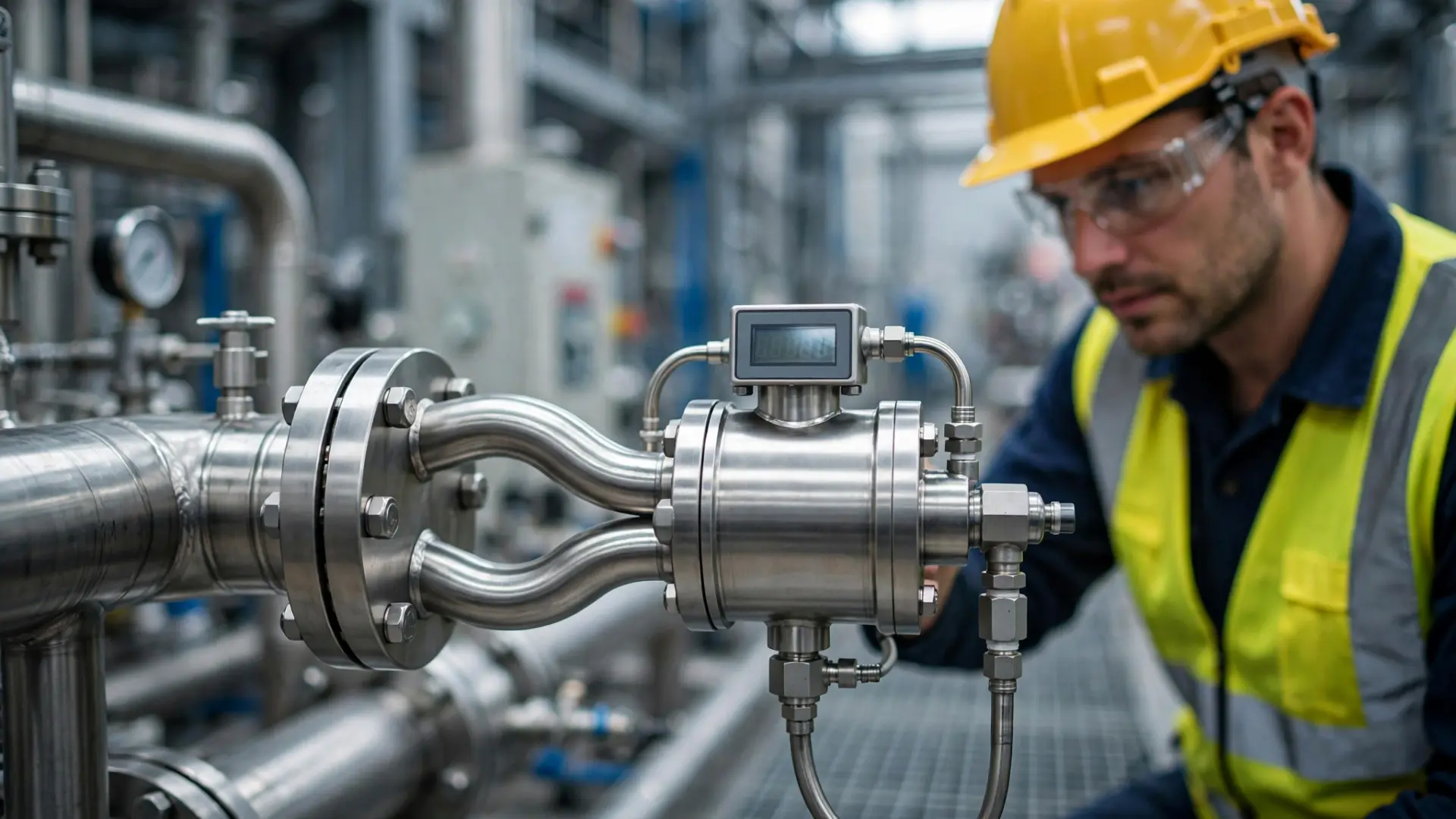
Selecting a Coriolis flow meter? These 7 factors — flow range, accuracy class, process conditions, materials, outputs — help engineers size it right.
Choosing the right Coriolis flow meter is rarely about picking the most accurate instrument on the datasheet. It is about matching seven practical factors — flow range, accuracy class, process conditions, wetted materials, connections, outputs, and lifecycle support — to your actual duty. Get any one of them wrong and you pay for it twice: once in the purchase price, and again in poor measurement or early failure. This guide walks through what experienced engineers check first, so you can specify a Coriolis meter with confidence.
1. Match the Flow Range and Turndown to Your Real Duty
A Coriolis meter measures mass flow directly, but its accuracy specification only holds within a defined flow range. The single most common selection mistake is oversizing: a meter sized for a peak flow that occurs twenty minutes a day spends most of its life at the bottom of its range, where percentage error grows.
Start from your normal operating flow, not the pipe size. Then check the meter's turndown ratio — the ratio between maximum and minimum measurable flow while holding the stated accuracy. A 20:1 turndown means a meter rated 0–1,000 kg/h still holds accuracy down to 50 kg/h. Batching and dosing applications with wide flow swings need more turndown than a steady-state transfer line.
Also verify the zero stability figure on the datasheet. At low flows, zero drift dominates the error budget, so a meter with better zero stability keeps its accuracy where you actually operate. If your process runs below 10% of nominal range most of the time, step down a size rather than accepting degraded accuracy.
2. Pick the Right Accuracy Class for the Job
Coriolis meters are typically offered in classes such as ±0.1%, ±0.15%, and ±0.5% of mass flow rate. The temptation is to default to ±0.1%, but accuracy costs money — and not every application repays it.
±0.1% is the class for custody transfer and fiscal metering — LNG, refined products, hydrogen refueling — where measurement error translates directly into commercial loss. ±0.15% suits high-value process control: chemical dosing, blending, and reaction feed, where repeatability drives product quality. ±0.5% is more than adequate for general process monitoring and utilities, where the alternative was a volumetric meter with far larger total error.
One caution: datasheet accuracy is always stated under reference conditions. Real installed accuracy also depends on zeroing practice, mounting, and process stability — a properly installed ±0.15% meter outperforms a poorly installed ±0.1% one. For cryogenic LNG service, where every tenth of a percent counts commercially, dedicated designs such as the CMASS025LD LNG Coriolis mass flow meter with ±0.1% cryogenic accuracy are worth the premium.
3. Check Process Conditions: Pressure, Temperature, Viscosity
Coriolis meters handle conditions that defeat most other principles — but every design has limits, and exceeding them silently degrades accuracy or destroys the sensor.
Pressure: check both the maximum working pressure and the pressure-effect specification. High-pressure service such as CNG or hydraulic oil needs reinforced measuring tubes; a standard meter on a high-pressure line is a safety incident waiting to happen.
Temperature: standard designs cover roughly −50 to +200 °C, with cryogenic and high-temperature variants beyond that. Rapid temperature cycling can shift the zero, so batch processes with steam-out or CIP cycles deserve attention — hygienic designs such as the pharmaceutical and chemical Coriolis meter are built for exactly those cleaning regimes.
Viscosity: genuine strength of Coriolis technology is its wide viscosity independence. Still, very viscous media at low flow can damp tube oscillation, so confirm the specific combination of viscosity and flow rate with your supplier rather than assuming.
Also consider entrained gas. Two-phase flow is the classic Coriolis headache: it does not damage the meter, but it temporarily degrades accuracy. If your process flashes, cavitates, or slugs, discuss it openly — there are installation and configuration mitigations, but only if your supplier knows.
4. Choose Wetted Materials for Your Medium
The measuring tubes are the wetted heart of the instrument, typically 316L stainless steel as standard, with options such as Hastelloy or other alloys for corrosive service. Match the material to your medium's corrosion data, not to habit — and remember that the transmitter housing matters too in washdown or offshore environments.
For hygienic applications in food, beverage, and pharma, look for polished surfaces, drainability, and cleanability ratings that match your CIP/SIP procedures. Material certificates (such as 3.1 mill certs) are worth requesting up front for regulated industries rather than chasing them during commissioning.
5. Specify the Right Process Connections
Flanged, threaded, hygienic clamp, or weld ends must match your piping standard and pressure class. A frequent and expensive error is specifying the meter in one flange standard and discovering the plant uses another. Confirm face-to-face dimensions early if you are replacing an existing meter in a fixed spool piece.
Compact U-tube designs can save the day in tight skids, but only if the dimensions actually fit. Send your supplier the installation drawing before ordering — a five-minute check beats a return shipment.
6. Plan Outputs and System Integration
A meter that cannot talk to your control system is a very expensive pipe spool. Before ordering, list what your DCS, PLC, or SCADA actually accepts: 4–20 mA, pulse/frequency, HART, and Modbus RTU/RS-485 cover the vast majority of installations.
Think about what the outputs should carry. Mass flow is the obvious one, but Coriolis meters simultaneously measure density and temperature — density output can double as a concentration or quality signal (Brix, °API, blend ratio) at no extra hardware cost. Decide during selection whether you need two analog channels, a pulse output for batching totalizers, or digital communication for diagnostics.
Finally, check the local display and configuration. A backlit display showing flow, total, density, and temperature speeds up commissioning enormously, and guided setup menus reduce dependence on specialist tools.
7. Evaluate Lifecycle Support, Not Just the Datasheet
The purchase price is typically a fraction of the meter's lifecycle cost. Before committing, ask practical questions: is calibration traceable, and can the meter be recalibrated locally or must it ship back? Are spare transmitters and seals available with realistic lead times? Does your supplier provide sizing help, commissioning support, and troubleshooting when the process throws a surprise?
Installation matters as much as selection. Coriolis meters need no straight pipe runs — a genuine advantage — but the sensor must stay full of fluid, gas pockets must be avoided, and zeroing under real process conditions (full of fluid, at operating temperature and pressure, with no flow) is the single most neglected commissioning step. Most "inaccuracy" complaints trace back to a bad zero, not a bad meter.
This is where working with a focused solution provider pays off. At VIBOTRA, we help engineers size and select Coriolis meters from real process data — flow profiles, fluid properties, accuracy targets — and we stay involved through commissioning and beyond. The right meter is the one that measures correctly for ten years, not the one with the glossiest brochure.
If you have process conditions or a datasheet in hand, talk to our engineers — a ten-minute sizing review now prevents a costly reselection later.
FAQs
What size Coriolis meter do I need?
Size to your normal operating mass flow, not the pipe diameter. Choose a meter whose accurate range covers your minimum sustained flow with margin, checking turndown ratio and zero stability — not just the maximum flow figure.
Is ±0.1% accuracy worth the extra cost?
For custody transfer and fiscal metering, yes — measurement error is direct commercial loss. For general process monitoring, ±0.5% is usually sufficient and far cheaper. Match the class to the application's economic stakes.
Can a Coriolis meter handle viscous fluids?
Yes — Coriolis measurement is largely viscosity-independent across a wide range. At very high viscosity combined with low flow, confirm the specific combination with your supplier, as heavy damping can affect performance.
Do Coriolis meters need straight pipe runs?
No. Unlike turbine, vortex, or orifice meters, Coriolis meters have no straight-run requirements upstream or downstream, which simplifies installation in compact skids.
How often should a Coriolis meter be recalibrated?
With no wearing moving parts, Coriolis meters are inherently stable; typical recalibration intervals run 1–3 years depending on your quality system. Many users verify in place with transmitter diagnostics and recalibrate only when the process demands it.