LNG Custody Transfer with Coriolis Mass Flow Meters
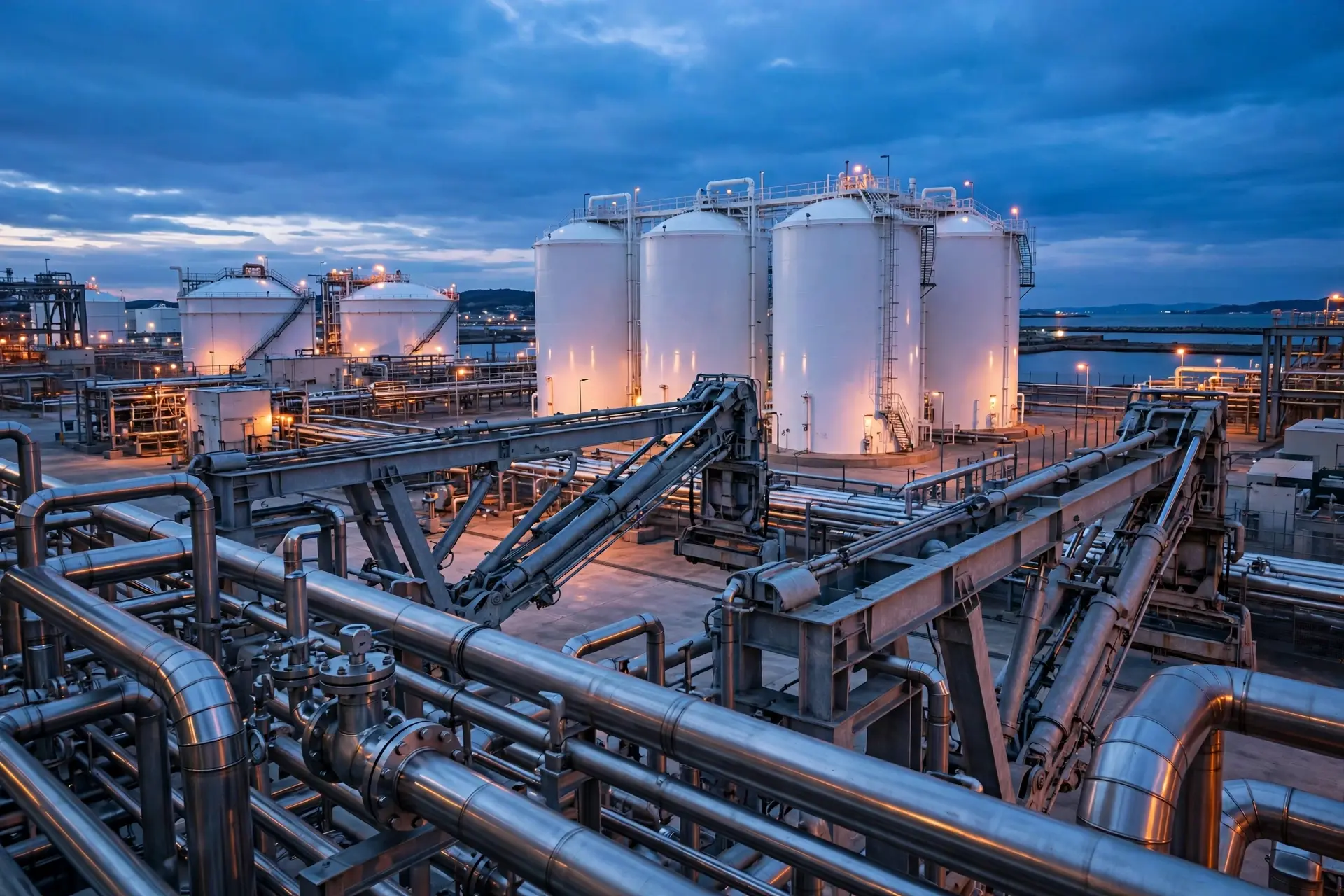
Why LNG custody transfer needs Coriolis mass flow meters: cryogenic metering at -162°C, direct mass measurement, and ±0.1% accuracy for fair trade settlement.
When liquefied natural gas changes hands, every fraction of a percent in measurement error translates directly into money gained or lost. That is why an LNG coriolis flow meter has become the instrument of choice for LNG custody transfer flow measurement at terminals, satellite stations, and truck loading bays. Unlike volumetric technologies that infer mass from volume and density, a Coriolis meter measures mass flow directly — even at the cryogenic temperatures where LNG lives.
Why LNG custody transfer comes down to mass
LNG is bought and sold by energy content, which is derived from mass. A cubic meter of LNG does not always contain the same mass: composition varies between cargoes, and density shifts with temperature and pressure. Volumetric meters must therefore be paired with separate density and temperature instruments, and the final mass figure is a calculation built on three separate measurements — each contributing its own uncertainty. A Coriolis mass flow meter collapses that chain into a single device that outputs mass flow directly, removing two layers of compounded error. For custody transfer, where buyer and seller must agree on one number, fewer assumptions mean fewer disputes.
The cryogenic challenge: metering at -162°C
LNG is stored and transferred at approximately -162°C, a temperature at which ordinary instrument materials become brittle and seals fail. Cryogenic-rated Coriolis meters are built with stainless steel measuring tubes and electronics designed to operate reliably across extreme thermal gradients. Just as important is thermal stability during operation: as cold LNG flows through the meter, the tube must maintain its calibrated oscillation characteristics. Purpose-built cryogenic Coriolis designs account for this, delivering stable readings from the first cooldown through continuous loading cycles. When evaluating a meter for LNG service, always confirm its rated temperature range covers your coldest operating point with margin.
Direct mass flow vs volume plus density conversion
The traditional approach to LNG measurement combines a turbine or ultrasonic volumetric meter with a densitometer and temperature transmitter, then computes mass in a flow computer. This works, but it has structural weaknesses: the density measurement is typically taken at a single point that may not represent the full flow profile, and any lag between the three instruments introduces transient errors during flow changes — exactly when loading arms start up and shut down. A Coriolis meter measures mass flow and density simultaneously in the same vibrating tube, so the two values are inherently synchronized. The result is a cleaner mass total during batch operations such as truck or ISO container loading, where start-stop transients dominate the measurement.
What ±0.1% accuracy means for your bottom line
Coriolis mass flow meters for LNG service typically offer accuracy of ±0.1% to ±0.15% of mass flow rate, with excellent repeatability. To put that in commercial terms: on a terminal moving hundreds of thousands of tons per year, the difference between ±0.1% and ±0.5% measurement uncertainty can represent a very large annual value at stake. High accuracy also reduces the measurement uncertainty that both parties must build into contracts, narrowing the tolerance band around each transaction. For operators handling LNG with a dedicated cryogenic Coriolis meter such as the CMASS025LD, the combination of direct mass measurement and custody-grade accuracy turns metering from a source of commercial friction into a settled fact.
FAQs
Why is a Coriolis meter preferred over ultrasonic for LNG custody transfer?
Ultrasonic meters measure volume and need separate density data to derive mass. Coriolis meters measure mass directly and simultaneously report density, which simplifies the measurement chain and reduces compounded uncertainty — a decisive advantage when the measured value determines payment.
Can Coriolis meters handle the -162°C temperature of LNG?
Cryogenic-rated Coriolis meters are specifically designed for LNG temperatures, with measuring tubes and materials qualified for continuous cryogenic service. Always verify the individual meter's rated temperature range before specifying it for LNG duty.
Do Coriolis meters need straight pipe runs like turbine meters?
No. One of the practical advantages of Coriolis technology is its very low sensitivity to flow profile distortion, so long upstream and downstream straight runs are generally not required. This simplifies installation at crowded loading skids and retrofit sites.
What maintenance does an LNG Coriolis meter need?
There are no moving parts in contact with the fluid — measurement is based on tube vibration — so wear is minimal. Routine verification typically consists of periodic zero checks and calibration verification against a reference, with intervals set by the operator's quality procedures.
Can one meter cover both small and large LNG flow rates?
Coriolis meters are available in a wide range of line sizes. For small-scale LNG distribution such as truck loading or bunkering, compact cryogenic models like the CMASS008LU LNG Coriolis mass flow meter are designed for lower flow ranges while maintaining cryogenic precision.
Accurate LNG custody transfer starts with the right measurement principle. If you are specifying meters for an LNG terminal, satellite station, or loading skid, contact VIBOTRA for sizing support and application guidance — our engineers will help you match the meter to your flow range, temperature conditions, and contractual accuracy requirements.